„Herbalculture – Cultureherbs„
Herbs know no borders
A project for intercultural exchange and connection
People from a wide variety of backgrounds come together to immerse themselves in the world of herbs. Ideally, a person who knows herbs will lead the meeting and bring along a nice program that focuses on making products from herbs – such as ointments, teas and more. It’s all about having a good time together and being inspired. The herbs also serve as a medium to bring in your own knowledge from other countries, so that everyone involved gains new insights. Herbs can be wonderful ambassadors of different customs and commonalities and thus become the basis for a new, honest bond.
Where could a „Kräuterculture – Culturekräuter“ event take place?
This would be possible in any public building: libraries, community centers, meeting places, clubhouses, … and especially in institutions and associations that take care of refugees and their integration.
Gather background knowledge
It is certainly helpful to contact an association that already has experience with refugees and migrants in order to find out about the specific characteristics of the different nationalities: Religious affiliations and associated taboos or „no-goes“; war history and traumatic backgrounds to consider as a result.. But don’t worry, you don’t have to become an expert on these things. Just keep this background knowledge in mind to create a safe space for the participants. The topic of herbs is basically a wonderful and harmless basis on which to build a trust-building exchange.
Who could organize this event and who could take part?
When it comes to herbs and their processing, this afternoon should be led by someone who is familiar with herbs and, if possible, has undergone minor or major training in this area; e.g. herbal educators, medicinal plant experts or similar.
It would be nice to get a few „locals“ on board and perhaps an equal number of migrants. It would also be exciting to vary the age groups so that you can look back further into the old customs and, on the other hand, create new memories with the younger ones.
What about the costs?
It goes without saying that time is just as important as money these days. Organizers should therefore consider the value of their events in advance and how they could be compensated. It’s not about sacrificing yourself, but about giving yourself away; this means possibly sharing the costs of materials and time among the participants or asking a participating association to generate funding for this. You could also make a public appeal for donations for the implementation. If you would like to offer your services free of charge and on a voluntary basis, this is of course the best option.
What about insurance?
On the one hand, it’s good to have liability insurance that covers teaching and handling herbs if you work with them professionally. Otherwise, you can also draw up a written agreement that excludes your liability for any damage caused to participants. You can then have this signed at the start of the event. Make sure you have a clear picture of who is liable for what in the event of damage. Talk to the club or organization providing the rooms.
Legal aspects
There are legal requirements that must be observed when handling herbs and producing cosmetics. Here are just a few examples: You are not authorized to give health advice or make healing promises. However, if you have received training in medicinal plants, then you have been well trained in legal matters and only need to refer to your documents again.
Do good and talk about it!
For an event like this, which has been brought to life with a lot of love and thoughtfulness, it is worth writing about it in the local media and also on social media. This is the positive news we need today. Get a local reporter or write about it yourself and provide vivid pictures.
Sharing is caring!
This idea may have been initiated by one person, but it has the desire to be carried further. So let yourself be inspired, implement it with pleasure and share the idea with others in other places in Germany or elsewhere in the world. Let this project grow and develop on its own. Feel free to share your experiences with me and others so that they can avoid any mistakes and don’t have to reinvent the wheel.
How did I come up with the idea for this project?
This project is my response to the charged atmosphere in our country and in the world in general. I don’t really want to integrate politics into my work, but I guess it’s inevitable as soon as you deal with other people and especially with herbs. People bring personal and social interaction with them, and herbs act as an interface between people and nature. This is also about environmental protection and global developments such as climate change, wars and other conflicts. I see myself as a citizen of the earth and consider it a great privilege to be human and to live in a very free country. I feel no collective guilt or desire to make amends for past atrocities committed by previous generations. Rather, I feel the need to take responsibility for good coexistence in the mirror of history. Saving the world is not my ambition, but my heart’s desire is to influence and help shape my surroundings on a small scale. Perhaps this will make the world an increasingly better place after all.
Talk to me!
I really hope I have been able to inspire you! I’m sure there are other questions you’d like to ask me. You are also welcome to contact me with further ideas and inspirations so that I can share them with others. I see this as a joint project that can develop a very lively dynamic.
Sharing experiences
I don’t yet know which platform would make sense for sharing ideas. For now, I’ll let the threads come together and ask you to share your thoughts with me. There are now so many possibilities, but I would like to choose the one that is feasible for most people.
What could an intercultural day in the name of herbs look like?
Herbs play a role in every culture; no matter where people come from, they always bring with them knowledge about herbs and the stories associated with them. Perhaps some people are no longer aware of this because the memory of it is deeply buried under painful and tragic stories. But in a relaxed atmosphere and a friendly get-together over a cup of herbal tea, memories of happier days may come flooding back.
An afternoon in the spirit of „Kräuterculture – Culturekräuter“ could develop something like this, when Germans, migrants and asylum seekers drink tea together and get in the mood for a creative time. The medium of communication is the herbs and the activities with them:
Perhaps there was also tea at home. The first images emerge, words form from them and take the others on a journey to a distant land. Language may not be enough to express what is inside, but the eyes reflect feelings; a smile on the lips, a dreamy look, a hand that rests supportively on the shoulder. Someone else speaks, begins to talk, in broken German, perhaps also in their mother tongue, while someone else translates. A German participant listens intently and also begins to share her knowledge with the group. She also asks for simple terms: What does leaf mean in your language? What do you call this plant? What does flower mean?
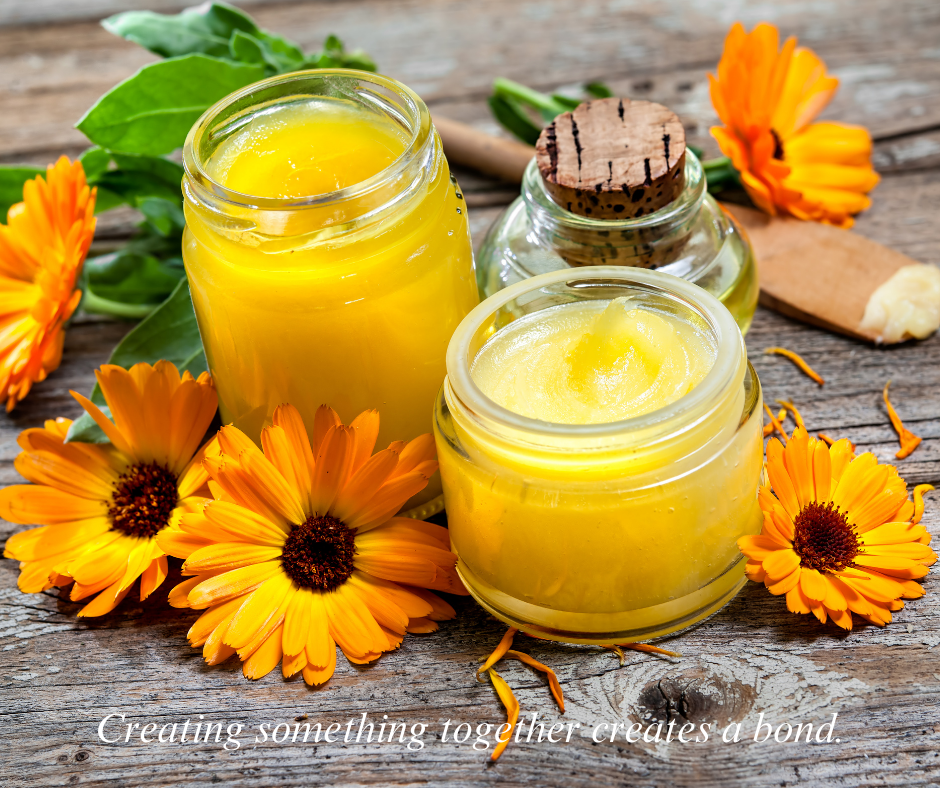
After a while, the mood in the room has clearly changed. The initial self-consciousness of the six German participants and the other six participants, who come from Syria, Afghanistan, 2 Sudan and 1 Ethiopia, has dissipated. Everyone has a smile on their lips and a sparkle in their eyes. And a new energy fills the room: it’s curiosity. Curiosity about the others, curiosity about what is yet to come. Because they are about to make a marigold ointment together. None of them had ever done that before…